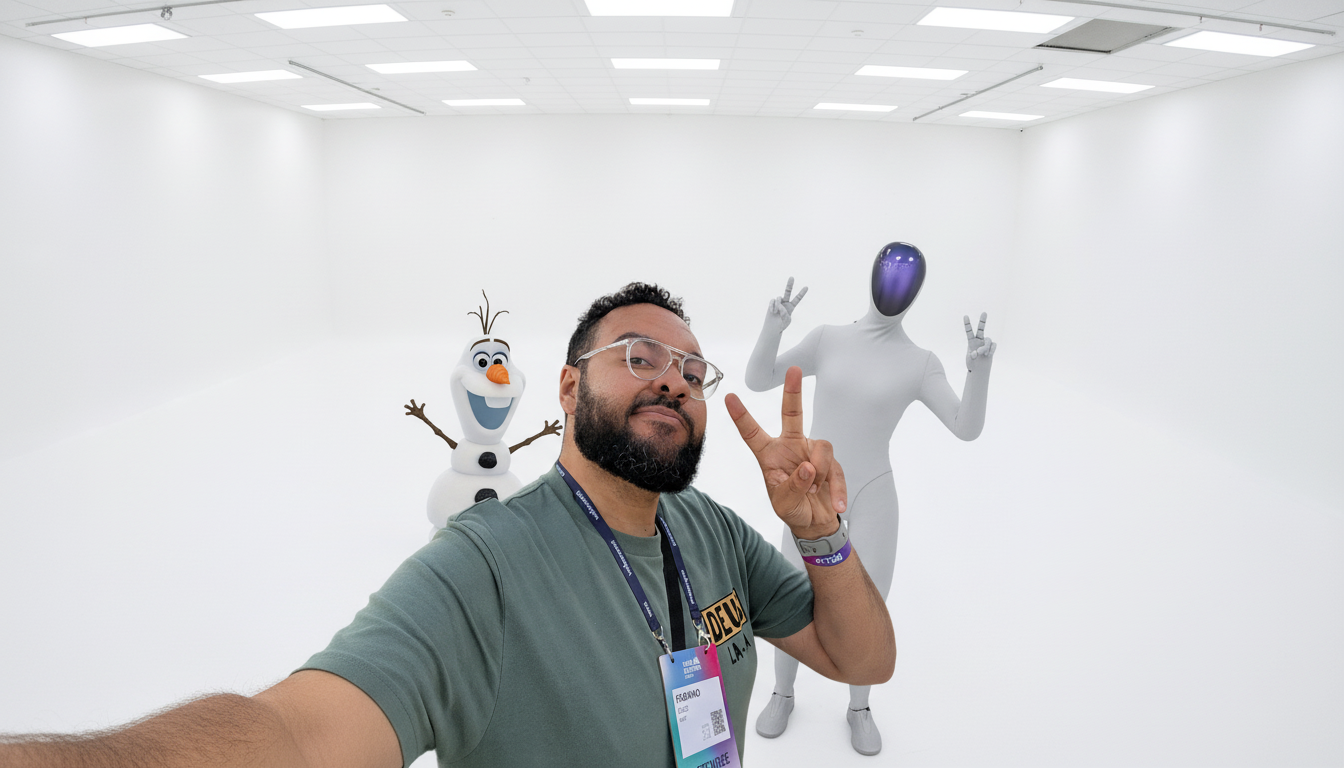
If you have heard of Embodied AI and felt a little uneasy about the term, do not worry. I am not referring to conscious machines or dystopian narratives. What is happening is far more tangible—and, at the same time, profoundly transformative.
Artificial intelligence is beginning to gain a physical presence. It is no longer confined to standalone software running locally or in the cloud; it is starting to interact directly with the physical environment. It can perceive the space around it, interpret what is happening, and act within that same space. For a long time, AI was like a brain without a body, limited to the digital world. It is now beginning to develop senses and movement, fundamentally changing our relationship with technology.
This shift is reminiscent of the evolution of electricity. At first, it was visible, noisy and even uncomfortable. Today, it is invisible and essential. Artificial intelligence is following a similar path. For years, it was associated with technical interfaces and abstract systems. It is now becoming embedded in the physical economy, dealing with weight, space, gravity and time. It is no longer simply about analysing information, but about acting in the world as it actually is.
What once seemed like science fiction—such as in the series Westworld, among many others—is already happening in real-world environments. Speaking of theme parks with robots, The Walt Disney Company began with Olaf, available in 2026 at Disneyland Paris and Hong Kong Disneyland. BMW tested the Figure 02 robot on operational production lines, where it carried out repetitive tasks with consistent precision at an industrial pace. In Latin America, Mercado Libre began integrating the Digit robot into fulfilment operations to take on physically demanding activities, reducing human effort and the risk of injury. In China, AI-coordinated drones and autonomous machinery have been used to rebuild long stretches of road without exposing workers to hazardous conditions. Yes, this is happening. Search for it using your preferred GenAI tool if you would like to explore further.
Perhaps the most revealing example of the current maturity of this technology comes from XPENG. At the launch of its Iron humanoid robot, its walking motion appeared so natural that it immediately prompted public scepticism. To dispel any doubt, the company decided to cut open the robot’s leg during the presentation, simply to prove that there was not a person inside. That moment says a great deal about where we are today. We are no longer debating whether robots can move convincingly; we are debating whether they move too convincingly.
For that level of realism to be possible, these systems need far more than conversational models. They must understand the visual environment, connect perception to language, and turn it into coordinated physical action. This is where Vision-Language-Action (VLA) models emerge, functioning as a kind of artificial nervous system. Technologies developed by companies such as NVIDIA and Figure AI enable robots to learn new tasks by observing, testing and refining their own movements, rather than relying solely on rigid instructions.
Another decisive factor in this transition is the way we interact with these systems. Voice is emerging as the most natural interface. Today, this is already apparent with AI agents; soon, simply speaking to a robot will be enough to coordinate complex actions. Solutions such as Google’s Gemini Robotics enable people to communicate their intentions in simple terms, while the system interprets context, plans the necessary actions and carries them out safely. Technology stops demanding advanced technical knowledge and begins to respond to human intent.
The figures confirm that this is not a passing curiosity, but a structural shift. The global humanoid robot market, valued at US$290 million in 2024, is projected to reach US$1.24 billion by 2032. In logistics and industrial settings, studies suggest that humanoid robots could reduce serious injuries associated with repetitive strain by as much as 40%, particularly injuries affecting the back and joints.
For me, this progress goes beyond operational efficiency. It connects directly with my passion for user experience and martech. UX is no longer limited to the digital world; it now unfolds in the physical world, through gesture, voice and context. The principle of “understand in order to serve” takes on a new dimension, in which understanding the user means recognising their intentions and responding naturally. This is where new narratives and journeys begin to emerge—far more human and seamless.
And, to round things off, this article echoes the title of a talk at this year’s Web Summit: “Your new colleagues do not eat birthday cake.” Do you want to be among those who see only the negative side, or will you learn, adapt and take the first step into this new kind of UX?
Originally published on LinkedIn (in Portuguese).